Posts

COD Test!

Image
This is a test that measures the Chemical Oxygen Demand (COD) in water! COD is a measure of how much oxygen needs to be consumed in order to chemically react with the organic matter in a solution. In other words, COD measures how much organic matter is in a solution by asking "how much oxidation would need to happen to eliminate all these organic compounds?". It also happens to be a very colorful test.

Our new sand filter pre-treatment device!

Image
Is this what you thought a sand filter would look like? This is our new state-of-the-art sand filter device that we use to pre-treat water that goes into the AOS Prototype, ensuring the water doesn't contain excess levels of solids and other troublesome materials before it enters the AOS.

BioLargo Water Lab Pictures!

Image
Have a peek at some pictures of BioLargo Water lab members at work! AOS Technician Ted is testing out a new pump prototype Lab meeting time! New AOS Prototype canisters constructed, ready to be assembled with interior components

BioLargo Water Tour at EPCOR's Gold Bar Wastewater Treatment Plant

Image
Recently, scientists from BioLargo Water were fortunate enough to enjoy a private tour at Gold Bar, Edmonton’s largest wastewater treatment plant. Gold Bar is owned and operated by EPCOR, Canada’s oldest municipally owned utility company, and is one of Canada’s largest Class IV wastewater treatment plants. This tour was an excellent opportunity for our junior scientists to learn, in-person, about the operation and challenges of a large wastewater treatment plant. The Gold Bar plant has a capacity of 310 million liters per day and serves a population of around 1 million people. Its treatment process consists of pre-treatment in grit tanks, sludge separation in primary clarifiers, breakdown of dissolved organics in a biological treatment process, and tertiary treatment using UV disinfection before discharge into the North Saskatchewan River. The whole process takes 18 hours! At BioLargo, we intend to offer our Advanced Oxidation System (AOS) as a tertiary treatment for wast...

AOS Vs. Protozoa

Image
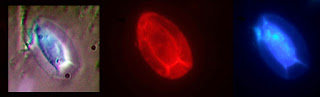
Why do we treat water? While a big part of why people invest so much in water treatment is to remove contaminants like toxic organic chemicals and inorganic contaminants like salts and metals, often the most pressing threats in untreated water are pathogenic organisms. Pathogens are microscopic organisms that include bacteria such as E. coli and Salmonella and viruses such as norovirus, but can also be parasitic protozoa such as Giardia lamblia , the organism that causes "beaver fever". These organisms are often more difficult to kill, and can cause serious illness if ingested. Until recently, we at BioLargo Water focused much of our research on our Advanced Oxidation System's (AOS) ability to kill bacteria and viruses endemic to industrial livestock and agricultural wastewater treatment settings because of large market pull from those industries. Just recently, however, we started a research project to prove the AOS can kill protozoa like Giardia . Gi...

Water Risks in Canada

Image
Clean water is becoming increasingly scarce the world over, spurring on the advancement of technical solutions like our Advanced Oxidation System (AOS) to help enable water reuse and recycling. At BioLargo Water's laboratory space and offices in Edmonton, AB, the looming threat of fresh water scarcity can seem quite distant, with the North Saskatchewan River flowing fast and clean through the city and the recent years of steady rainfall. The reality, however, is that clean water scarcity is closer than most people in the city realize (both in terms of time, and geographically). A recent story published by CTV News reports that the Northern Canadian cities like Iqaluit, Nunavut, might soon run out of clean water, an effect attributed to rising average temperatures in the North due to climate change. The Apex River, which provides Iqaluit's fresh water, is projected to have reduced flow by the year 2024. Iqaluit, Nunavut - Adrian Wyld / THE CANADIAN PRESS This trend has ...

Meet the BioLargo Water Team

Image
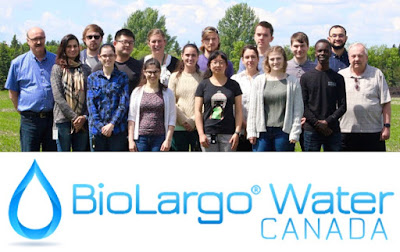
The BioLargo Water research and development team met for a weekly lab meeting on Friday, and it happened to be a (rare) warm and sunny day in Edmonton, AB. The company R&D team is comprised of hardworking PhDs and MScs and undergraduates in a variety of fields, including chemical engineering, environmental engineering and microbiology.